


Anna’s Trip to Brussels…
In September 2024, Anna travelled to Brussels to gather inspiration for new prints and to meet with Art Nouveau expert Dorka Demeter. Art Nouveau refers to a style that flourished from the late 1880s, characterised by flowing, organic lines, natural motifs, asymmetry, and a seamless blend of structure and decoration using both modern and traditional materials.
Its beauty appears in many forms – architecture, furniture, illustration, and decorative arts – and its imaginative, radical spirit marked a complete departure from the design traditions of the 19th century. The movement spread across Europe, capturing the cultural imagination and remaining an enduring source of inspiration today.
Anna: ‘’Visiting Brussels was such a huge treat for the eyes, the stunning Art Nouveau museums and buildings made me cry from taking in so much beauty and attention to craftsmanship and detail!
From the intricate carvings and the stained glass to the hand painted murals and tiling, the nuance of beauty for beauty’s sake, along with the elegance of the colour palettes and languid lines, my inspiration fires were fully stoked and notebooks and pencils were immediately needed to start designs in response to this visual feast.
With meandering shapes and fan/scallop motifs already in my design repertoire, the intake of the era ‘en masse’ churned and refuelled my passion for 1920’s/1930’s style and I was designing new prints and lighting forthwith.
Meeting Dorka Demeter was utterly charming, a true ambassador for the period and super knowledgable about the architecture, designers and craftspeople of the time. Seeing some of the sights through her eyes enhanced my trip and enriched the experience no end! Please enjoy our interview below where she explains in more detail her draw to all things Nouveau….’’
Interview with Dorka Demeter, Art Nouveau instagrammer
Instagram: @magic.of.artnouveau, @artnouveau.brussels
Born in Transylvania, the influencer inherited her passion for Art Nouveau from her mother. She has lived in Brussels for 14 years, where she had the opportunity to explore the city’s Art Nouveau heritage in depth during the first COVID lockdown. It was then when she launched her @magic.of.artnouveau Instagram profile, which counts by now almost 75,000 followers. This was followed by the @artnouveau.brussels Instagram profile that focuses on the Art Nouveau heritage of Brussels. She is the Art Nouveau Editor of welovebrussels.org where she has published several articles about architecture and heritage. In 2022, she became an individual member of the Reseau Art Nouveau Network (RANN). Wherever she travels, she photographs and shares Art Nouveau gems with her increasingly widening audience. This is how she has turned into a true ambassador of Art Nouveau style.


Personal Connection and Passion
Anna: What sparked your passion for Art Nouveau, and how did you come to focus more on Brussels?
Dorka: My love for this style derives from my childhood. My Mother is an ultimate Art Nouveau fan who would always look out for such houses and would save up her money to find and buy Art Nouveau treasures at flea markets. I was also lucky enough to spend every Thursday evening listening to classical music concerts during my school years as a music student in the famous Art Nouveau Palace of Culture located in my hometown, Marosvásárhely, Targu-Mures in Transylvania, Romania.
I moved to Brussels in 2010, where I was always astonished by the great variety of the Art Nouveau architectural heritage. However, it took a COVID lockdown to finally find the time to spend discovering it in depth. I had on my shelf books and maps including various Art Nouveau walks that just needed to be used finally. So, as we were allowed to do sports, I started walking along those routes: ending up walking 100km of Art Nouveau in 3 weeks’ time. That period gave birth to a whole new chapter in my life with a new identity, new friends, new stories to tell. A whole new world.
Back then, I had an Instagram profile with 200 followers – now the number of my followers has reached almost 60.000 becoming the largest profile that showcases Art Nouveau and publishes only photos of one’s own (@magic.of.artnouveau). Based on these experiences, in March 2022 I launched my second profile that was dedicated to showcasing Art Nouveau in Brussels (@artnouveau.brussels).
A whole new world that didn’t stay a virtual reality – that I was afraid of when becoming more active on social media. On the contrary, from virtual it became REALITY – written in capital letters. Reality with new daily discoveries, travels, Art Nouveau buddies from all over the world. My Instagram profile connects different people and regions, opening up new doors and worlds.
Anna: What is it about Art Nouveau that continues to inspire you personally?
Dorka: For me Art Nouveau represents universal and eternal beauty. Discovering such details during a daily routine walk or during my travels all over Europe inspires me wherever I go. There are always new stunning elements, shapes and forms, motifs of flowers and plants that add to my treasure box.

Art Nouveau in Brussels
Anna: Brussels is considered one of the capitals of Art Nouveau. How did this style take root here, and why is it so prevalent?
Dorka: It was in 1893, that architect Victor Horta finished the Tassel House. This building is the founding work of the Art Nouveau movement. The impressive modernity of its façade, its custom-made structure and the sumptuous interiors mark a milestone in the history of architecture – earning Brussels the title of cradle of European Art Nouveau. In Brussels there are over 1000 buildings that feature Art Nouveau style. Already back in the ‘90s the New York Times stated that Brussels was the Capital of Art Nouveau. This idea was reinforced last year as the year 2023 got dedicated to Art Nouveau in Brussels. A rich, accessible and inclusive program had been running throughout the whole year celebrating Art Nouveau in all its diversity.


Anna: What are the most iconic works of Brussels’ Art Nouveau movement?
Even to name the most iconic works would be a rather long list. However, let me point out a few houses that got again in the spotlight thanks to the Art Nouveau Year.
Maison Hannon – Avenue de la Jonction 1, 1060 Brussels
A landmark of the year was the opening of Maison Hannon as the newest Art Nouveau museum in town. Designed by architect Jules Brunfaut at the request of the Hannon couple, Marie and Édouard, in 1902, the Maison Hannon is a “portrait-house” conceived as a dreamlike, symbolist enclosed universe. It is not only an exceptional and unique example of the Art Nouveau architectural heritage, but a whole synergy between craftsmanship, cooperation and sustainability. Unlike a traditional museum, it is a whole concept!
Horta Museum – Rue Américaine 27, 1060 Brussels
Only 10 minutes’ walk from Maison Hannon, one can find architect Victor Horta’s iconic private house and studio, home to the Horta Museum. It is one of the four townhouses of architect Victor Horta that are part of UNESCO World Heritage: intricate forms and lines, incredible stained glasses, the variety of materials and techniques that cut the breath. Maison Hannon and Horte Museum can be visited with a combined ticket at a reduced price. Reservation to Horta Museum is obligatory.
Hôtel van Eetvelde – Avenue Palmerston 4, 1000 Brussels
Talking of UNESCO World Heritage townhouses of architect Victor Horta, Hôtel van Eetvelde is another one of them. This gem was hardly accessible these past years: any guided visit was instantly sold out. As part of the Art Nouveau Year, this house was restored and opened to the public.
Furthermore, the adjoining building, former office of the owner, Edmond van Eetvelde, was acquired by the city last year. These buildings are now connected by an innovative project, the LAB·AN, founded on the occasion of the thematic year, offers a contemporary look at Art Nouveau heritage. The buildings are open for visits on a permanent basis from Saturday to Monday. What better programme for a rainy weekend?!
Hôtel Solvay – Avenue Louise 224, 1000 Brussels
Another UNESCO World Heritage townhouse by architect Victor Horta – where the sky is the limit. Not only because of the impressive stained glass skylight dominating the staircase. But also because when Horta asked what the budget was for the project, the answer was: “there is no budget”. The facade underwent meticulous renovation during the last two years and now shines in its former glory. Book online!


Art Nouveau in Hungary
Anna: How does the Art Nouveau style in Hungary differ from that in Brussels? What are the cultural and artistic influences that shaped Hungarian Art Nouveau?
Dorka: These last 3 years I discovered and learnt a lot about Art Nouveau. I also learnt how closely it is connected with the search for identity of different nations at the turn of the century. While learning about other places and cultures, I discovered more and more the true meaning of Hungarian Art Nouveau. I am Hungarian from Transylvania. Coming from such a minority background, the question of cultural identity of a person is even stronger, even more important. My community is in a rather particular situation given the fact that we have been living on that territory for centuries while borders and thus the states have changed above our heads. At the turn of the 20th century my region, Transylvania in Romania alongside with Vojvodina in Serbia, southern Slovakia and Transcarpathia in Ukraine all formed along with the current state of Hungary the Kingdom of Hungary. As a solid cultural region and a single administrative territorial unit, it is not by surprise that one can find the handiwork of the same architects and artists all over the region. These works were often inspired by Hungarian folk motifs.
In personal conversations, Insta-posts and comments this topic of Hungarian Art Nouveau outside the borders of current Hungary comes up again and again. It has become a personal mission of mine, a certain type of cultural diplomacy, to find the right explanations and points of view to explain Hungarian Art Nouveau Without Borders. This serves the better understanding of the tight connection between certain cities and architectural heritage of East-Central Europe.
Anna: What are some of the must-see Art Nouveau buildings or interiors in Hungary that most people aren’t familiar with?

Dorka: Let me mention a few examples from Budapest that are worth a visit. The György Ráth Villa showcases the Art Nouveau collection of the Applied Art Museum – a stunning Art Nouveau building itself by Arch. Ödön Lechner that currently undergoes renovation. Another museum that I highly recommend is the Miksa Róth Memorial Museum – Miksa Róth was the most famous Hungarian stained glass master and mosaic maker of the time. And to add a third option to the list: Resoart – Kőrössy Villa is the first villa in Budapest influenced by French and Belgian floral Art Nouveau style. It hosts one of the largest and most stunning Zsolnay ceramics private collection. The good news is that since last summer English guided tours are also available.
Influence and Legacy
Anna: Do you think Art Nouveau still influences contemporary architecture and design today?
Dorka: I do think that Art Nouveau keeps influencing and inspiring contemporary artists and architects who seek to create beauty. Art Nouveau is experiencing a revival today as modern-day audiences start engaging and appreciating it. The Reseau Art Nouveau Network (RANN) – of which I am also an individual member of – does a great job in this regard connecting the main Art Nouveau cities and institutions all over Europe.
Hilda Horváth, curator of the permanent exhibition entitled ‘Art Nouveau – a Hungarian Perspective’ in the György Ráth Villa (Budapest, Hungary) put in words the most wonderfully what Art Nouveau – as we call it in Hungarian “szecesszió” – means to the modern-day admirer:

“O, Secession, what will you give us today? Subtle stirrings of the soul? Overflowing emotions? Nostalgia for an age bygone? Shapes that change incessantly? Carefree swaying along flexing twists and turns? The infinite power of nature? The eternal triumph of flowers? An exuberant cavalcade of colours and forms? Dark mystery and light, light and even more light? Evanescent moments in Time? A sense of the exotic or national pride? The cult of beauty and feminine glory? An unending source of eternity? The promises of the very last universal style? Yearned-for unity, the hoped-for Whole? All this and even more. This was indeed the Whole – before it all fell apart.”


Anna’s Art Nouveau Inspired Designs…
HORTIA
Hortia is a richly patterned, sculptural print, where curves and flowing lines elegantly nestle close to one another. The design feels timeless and fluid, inspired by Brussels’ Art Nouveau heritage. Soft, grounded, and inviting, it harmoniously blends organic forms with structured geometry.
Available in three colourways, in wallpaper and herringbone fabrics.


SHOWGIRL
Available as wallpaper, velvet fabric and lampshade

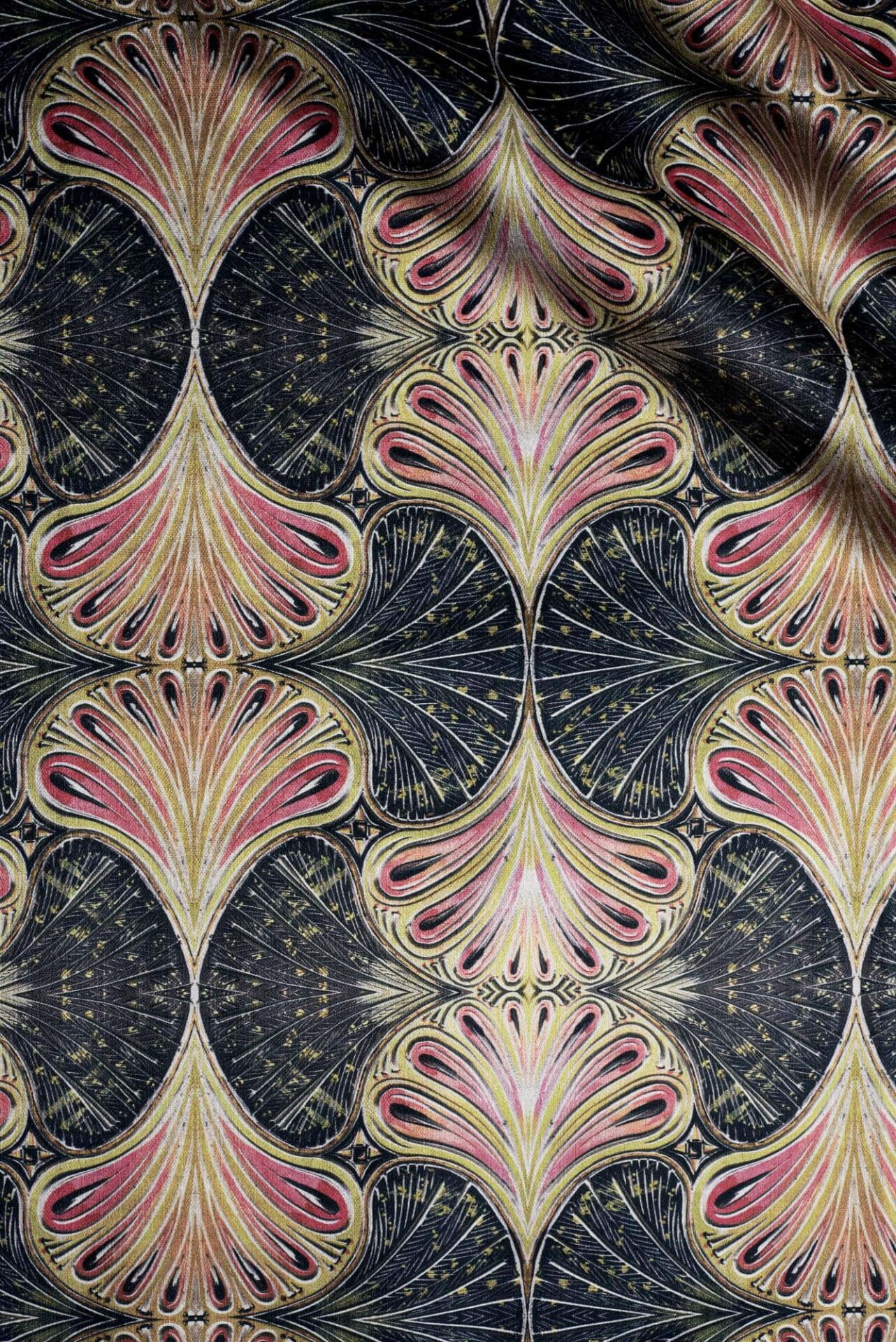
OYSTER
Available as wallpaper, fabric and lampshade


ARANA
Available as wallpaper, heavy satin fabric and lampshade


SERPIENTE
Available as wallpaper, heavy satin fabric and lampshade


